
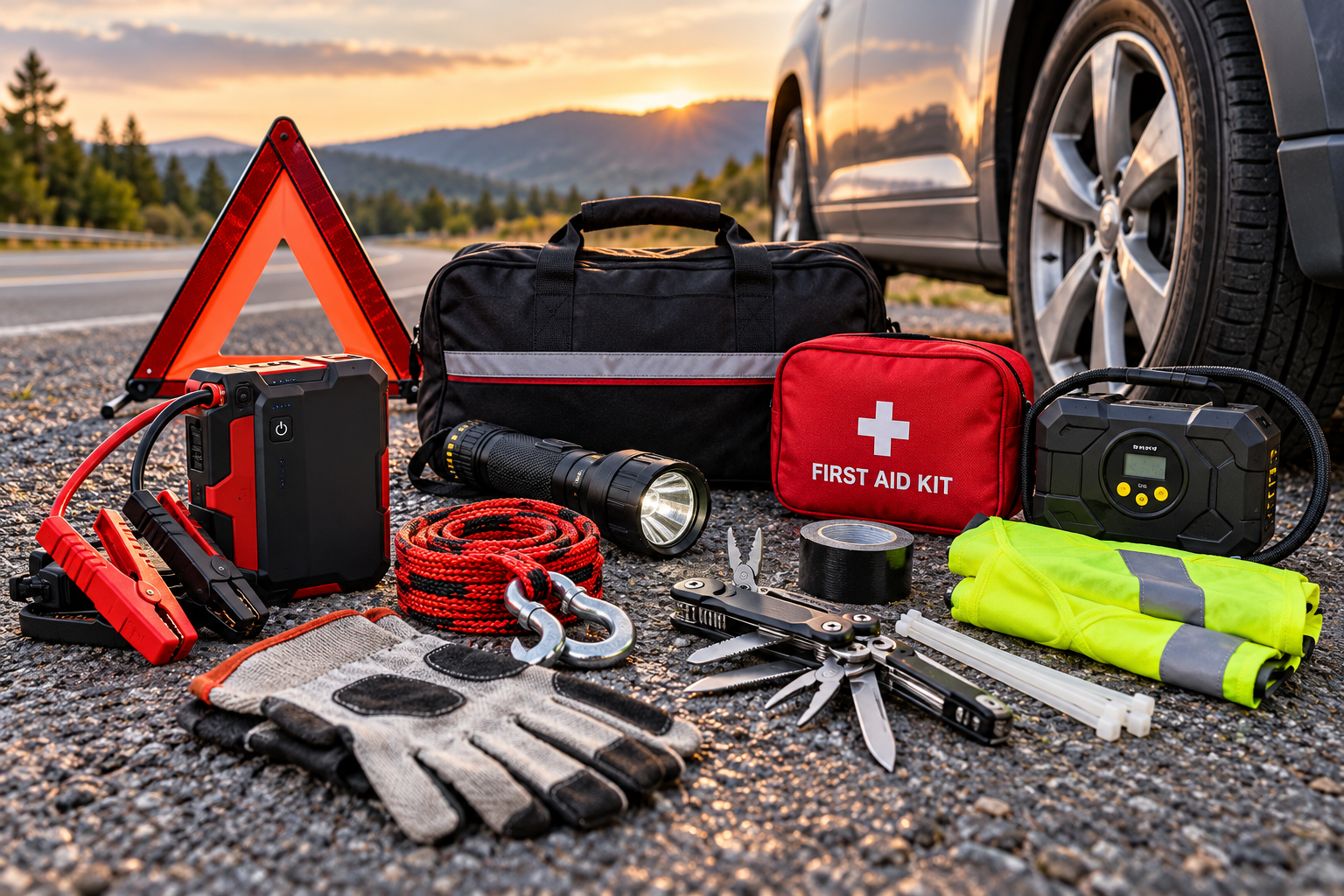
A roadside problem rarely happens at a convenient time. A dead battery, low tire, unexpected breakdown, or other problem can quickly turn an ordinary drive into a frustrating situation. Keeping a few practical items in your vehicle can make the difference between handling a minor problem yourself and being stranded waiting for help. Here are seven items worth considering for a basic roadside emergency kit-and what to look for when choosing them.
1. Portable Jump Starter
A dead battery is one of those problems that can leave you stranded even when there is nothing else wrong with the vehicle. A portable jump starter lets you attempt to restart the vehicle without needing another car and a set of jumper cables.
When choosing one, pay attention to the starting power, the engine sizes it is rated to handle, battery capacity, safety protections, and how easy the unit is to operate. Some models also include useful extras such as a flashlight, USB charging ports, or even a built-in tire inflator.
One important consideration is maintenance: a jump starter isn’t very useful if its internal battery has been sitting discharged in the trunk for months. Check its charge periodically and follow the manufacturer’s storage and charging recommendations.
2. Portable Tire Inflator
Low tire pressure can happen gradually or seemingly show up at the worst possible time. A portable tire inflator gives you a way to add air wherever you are, which may be enough to get you safely to a service station or repair shop when the tire is still capable of holding air.
Look for an inflator with an easy-to-read pressure gauge, automatic shutoff, a hose and power cord long enough to reach all four tires, and enough capacity for the type of vehicle you drive. Cordless models off convenience, while 12-volt models that plug into the vehicle can eliminate the worry of finding a dead battery in the inflator.
An inflator isn’t a substitute for repairing a damaged tire, and it won’t help with every flat. But for an otherwise sound tire that’s simply low on air, it can be one of the most useful tools to keep in the vehicle.
3. Flashlight or Rechargeable Work Light
Roadside problems don’t always happen during daylight. A dependable flashlight or rechargeable work light can make it much easier to inspect a tire, look under the hood, find something inside the vehicle, or simply make yourself more visable while waiting for assistance.
Look for a light that is bright enough for roadside use, easy to operate, and durable enough to live in a vehicle. A magnetic base or adjustable stand can be especially useful because it allows you to work with both hands free. Rechargeable models are convenient, while lights that can also use replaceable batteries provide another option when charging isn’t available.
Just like a portable jump starter, check the light occasionally to make sure it still works and has a usable charge. Emergency equipment is only valuable when it’s ready when you need it.
4. Reflective Warning Triangles or Emergency Lights
If you have to stop along the side of a road, being visible to approaching drivers can be just as important as dealing with the problem itself. Reflective warning triangles or emergency lights can help alert other motorists that a stopped vehicle or person is ahead.
Look for equipment that is highly visible, compact enough to store easily, and simple to deploy. Reflective triangles require no batteries, while LED warning lights can provide greater visibility in darkness or poor weather. Carrying both can provide useful redundancy without taking up much space.
Always put your own safety first when using roadside warning equipment. Avoid standing in traffic lanes, and don’t attempt to place a warning device somewhere that requires putting yourself in danger. If the location isn’t safe, stay clear of traffic and contact roadside assistance or emergency services when appropriate.
5. Tire Pressure Gauge
A tire pressure gauge is one of the simplest and least expensive items you can keep in a vehicle, but it can be surprisingly useful. It allows you to check tire pressure accurately instead of relying on appearance alone-because a tire can be significantly underinflated without looking obviously flat.
Digital gauges are easy to read, while traditional pencil or dial gauges don’t depend on batteries. Whichever style you choose, look for one that covers the pressure range required by your vehicle and is easy to use at the valve stem.
For normal driving, tire pressure should be checked against the vehicle manufacturer’s recommended cold-tire pressure, usually found on the driver’s-door placard or in the owner’s manual-not simply the maximum pressure printed on the tire’s sidewall.
6. Basic First-Aid Kit
A basic first-aid kit won’t fix a mechanical problem, but roadside emergencies aren’t limited to the vehicle. Minor cuts, scrapes, burns, or other injuries can happen while changing a tire, working around the vehicle, camping, traveling, or simply going about everyday life.
A practical vehicle kit should contain basic supplies such as adhesive bandages, sterile gauze, medical tape, antiseptic wipes, disposable gloves, and other commonly used first-aid items. Choose a kit that’s organized well enough that you can quickly find what you need rather than one that simply advertises a huge number of pieces.
Check the kit periodically for damaged packaging, missing supplies, and expired items. And remember that a first-aid kit is intended for basic care-it isn’t a substitute for professional medical attention when an injury or medical situation is serious.
7. Basic Tool Kit and Work Gloves
You don’t need to carry an entire garage toolbox in your vehicle, but a small selection of basic tools can be useful when something simple goes wrong. A compact kit containing items such as screwdrivers, pliers, an adjustable wrench, and a few commonly needed sockets can handle minor tasks without taking up much space.
A good pair of work gloves is worth keeping with the tools. Besides keeping your hands cleaner, gloves can provide some protection when handling dirty, hot, or rough components. Choose a pair that fits properly and still allows enough dexterity to work with smaller parts.
The goal isn’t to perform major roadside repairs. It’s simply to have enough basic equipment available when a small problem has a straightforward solution. If a repair is beyond your experience or can’t be performed safely where the vehicle is stopped, calling for professional assistance is the better choice.
Build a Kit That Fits Your Driving
There isn’t one roadside emergency kit that’s perfect for everyone. Someone who primarily drives a few miles around town may have different needs than someone who regularly travels long distances, drives in severe winter weather, or spends time in remote areas.
Start with the basics and build around the way you actually use your vehicle. Check your emergency equipment periodically, keep rechargeable items charged, replace expired supplies, and make sure everyone who regularly drives the vehicle knows where the equipment is stored.
A little preparation won’t prevent every roadside problem, but having the right equipment available can make an inconvenient situation easier–and sometimes safer–to handle.